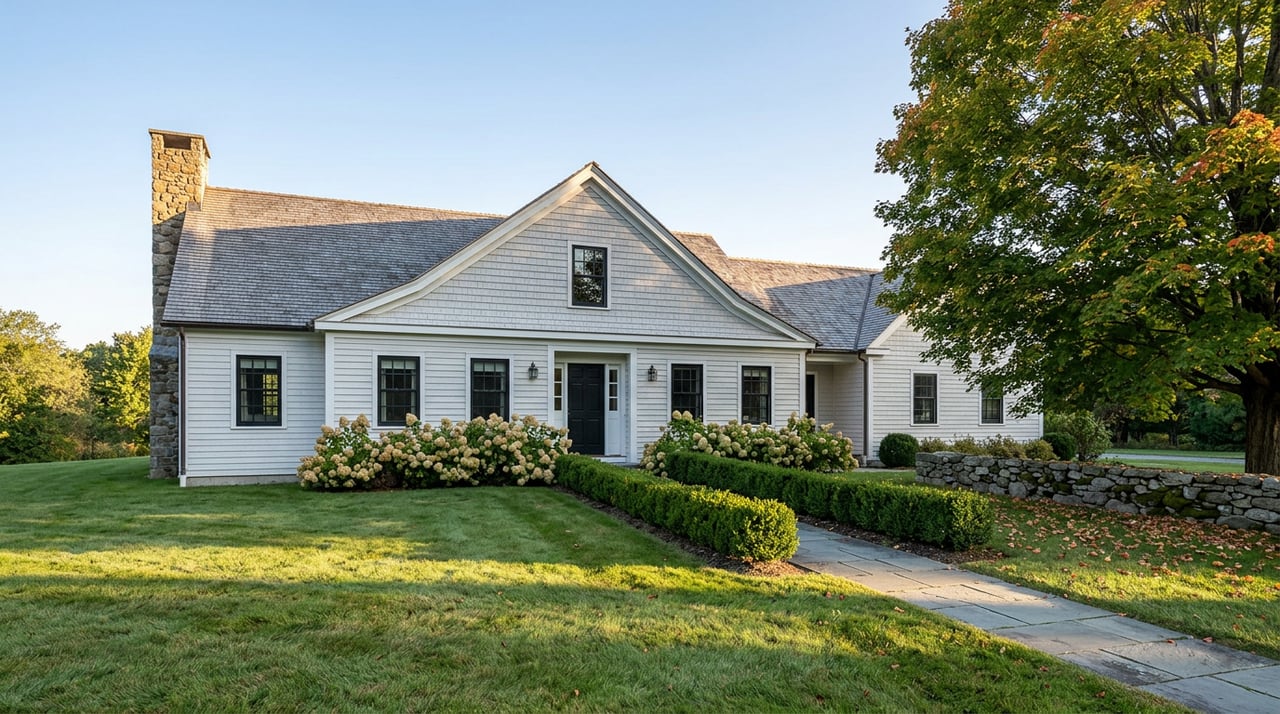
Drive down Harbor Road on a Sunday morning and someone will eventually tell you to slow down and look at the water. That is how most buyers find Southport. They came to Fairfield looking at the town-wide numbers, maybe cross-shopping Westport or Darien, and somewhere along the way a friend or an agent rerouted them past the Federal and Colonial facades lining Old Post Road. The conversation changes after that drive. So does the math.
Fairfield's median single-family sale price rose roughly 18.5 percent over the course of 2025 and crossed the seven-figure mark, landing near $1,072,500 by early 2026. That is a real number, and it is genuinely useful for comparing Fairfield to its Gold Coast neighbors, since comparable product in Westport and Darien routinely clears $1.5 million to $2 million. But treat that single figure as one market and you will misread every neighborhood inside it, because the number is an average of three sub-markets that do not behave the same way, do not move for the same reasons, and are not competing for the same buyer.
The Number Hides Three Different Mechanisms
Here is the part that surprises people who have already read a few Fairfield guides. Southport's median sale price sat at $1,340,000 as of July 2026, up just 0.6 percent over the prior year. Greenfield Hill, earlier in 2026, saw its median sale price climb more than 21 percent year over year, with days on market roughly doubling. The beach corridor near Jennings and Penfield doesn't show up in either of those patterns. It sells fast, prices tightly against square footage, and rarely makes headlines either way.
Three neighborhoods inside one town, three completely different pricing behaviors. That is not noise. It is structure.
| Sub-market | What actually drives the price | Recent price signal | Pace | Who is buying |
|---|---|---|---|---|
| Southport | Zoning-protected historic district, fixed supply | +0.6% YoY as of July 2026 | Slow to list, fast to sell once listed | Commuters who want a specific streetscape, not a floor plan |
| Greenfield Hill | Acreage and privacy, thin luxury land market | Sale price up over 21% YoY, days on market up over 100% | Long runway, high stakes per closing | Move-up buyers trading commute speed for space |
| Beach corridor (Jennings/Penfield) | Walkability and summer lifestyle, smaller lots | Competitive and consistent price per square foot | Fastest-moving segment in town | Buyers prioritizing beach access over lot size |
Southport's Calm Is Zoning, Not Coincidence
Southport's village center is a designated local historic district listed on the National Register of Historic Places, and Fairfield's zoning keeps it that way. New construction is not really an option here. The Pequot Library has stood on the same corner since 1894. The Delamar Hotel and Paci Restaurant, the latter housed in a converted historic train depot, anchor a small but well-regarded dining scene. Southport has its own Metro-North stop, a working harbor with the Southport Marina and Ye Yacht Yard, and Sasco Beach just south of the harbor, a quiet ten-acre stretch open to residents.
None of that inventory grows. That is the actual reason Southport's price barely moved over the past year while other Fairfield County luxury markets kept climbing. A market that cannot add supply does not need to chase demand with price swings. It just sits at a level buyers have already agreed is fair, and turnover stays low because families who get in tend to stay. When something does list on Harbor Road or Old Post Road, it moves quickly, but the town's zoning is the reason there is rarely much to move.
Greenfield Hill Is a Land Market Wearing a Neighborhood's Name
Greenfield Hill sits roughly four miles north of Fairfield's coastline, centered on a hilltop green and the Greenfield Hill Congregational Church, founded in 1725 and still hosting the neighborhood's Dogwood Festival each May. Bronson Road and Old Academy Road run through stone walls and two-plus-acre lots that make the area feel closer to rural New Canaan than to Fairfield's coast. The Town of Fairfield has its own historic district here too, drawn around the village green, the church, and portions of Bronson and Hillside Roads, but it protects something different than Southport's district does. Southport protects a walkable streetscape. Greenfield Hill protects acreage and setback.
That distinction is why the price behaves so differently. Greenfield Hill is not a volume market. A handful of estate-scale closings, a two-acre parcel on Fence Row Drive or a three-acre property on Dunham Road, can swing the year's median by double digits in either direction. As of March 2026, Greenfield Hill's median sale price was up more than 21 percent year over year, but days on market rose alongside it, more than doubling over the same period, which is normal in a market where the buyer pool is smaller and more deliberate. Buyers here are not comparing Greenfield Hill to the beach corridor. They have already decided they want land and privacy over walkability, and they are willing to drive ten to fifteen minutes to the Fairfield or Fairfield Metro train station to get it, since Greenfield Hill has no station of its own.
If you are watching Fairfield's town-wide median and wondering why it jumped or stalled in a given quarter, Greenfield Hill is often the reason. A thin market with expensive closings moves the average more than its share of total sales would suggest.
The Beach Corridor Is the Liquid Asset of the Three
Homes near Jennings Beach and Penfield Beach are a different product entirely. Jennings, at 27 acres, is the largest of Fairfield's public beaches and hosts the town's Fourth of July fireworks and the seasonal Sand Jam Family Fun Dance. Penfield, smaller at 3.5 acres, sits below the Penfield Beach Lighthouse, built in 1874, and anchors a stretch of Fairfield Beach Road lined with everything from original beach bungalows to new Craftsman-style construction. The Seagrape Cafe and Bar has served this stretch for forty years, and The Inn at Fairfield Beach sits at the corner of Fairfield Beach and Reef Road.
Lots here are smaller than in Greenfield Hill, and homes trade at a price per square foot that stays consistent rather than swinging with a handful of sales. That consistency is the point. This is a volume market. Enough comparable homes change hands each year that the price per square foot reflects real, current demand rather than a few outlier closings. Homes sell quickly here, and the price signal is one of the more reliable reads in town precisely because there is enough transaction volume to trust it.
Why the Mechanism Matters More Than the Median
If you are comparing Fairfield to Westport or Darien on price alone, you are missing the more useful question, which is what kind of asset you are actually buying. A Southport purchase behaves like a scarce, zoning-locked asset that holds its value with unusual steadiness. A Greenfield Hill purchase behaves like a land acquisition where the house is almost secondary to the acreage, and where price moves in bigger, less frequent steps. A beach corridor purchase behaves like a liquid, high-turnover market where you can trust the price per square foot because enough recent sales back it up.
Fairfield's discount to Westport and Darien is real. Comparable product in those towns often clears $1.5 million to $2 million against Fairfield's roughly $1.07 million town median as of early 2026. But that discount is not evenly distributed across Fairfield's own neighborhoods, and a buyer who picks based on the town-wide number alone may end up in a sub-market with a completely different risk and pace profile than the one they thought they were buying into.
A Few Questions Worth Settling First
Is Southport its own municipality? No. Southport is a village within the town of Fairfield and shares its town services, schools, and municipal government, even though its historic district gives it a distinct identity and its own Metro-North stop.
Do all three sub-markets share the same public schools? Yes. Southport, Greenfield Hill, and the beach neighborhoods are all part of Fairfield's public school system, which serves the entire town regardless of sub-market.
Which of the three holds value most predictably? Southport's zoning-driven scarcity has produced the steadiest recent price behavior, moving less than one percent over the past year. Greenfield Hill has shown the strongest price growth but with far more variability, since its market depends on a small number of high-value closings each year.
Understanding which of these three markets you are actually shopping in changes how you read every comp, every days-on-market figure, and every asking price you see. If you are trying to figure out where your search should focus, or how to position a Fairfield property for sale in the sub-market it actually belongs to, Pamela Cornfield can walk through the comparison in a confidential consultation built around your specific goals.
This article is general information, not legal, tax or financial advice. Consult a qualified professional about your situation.
